
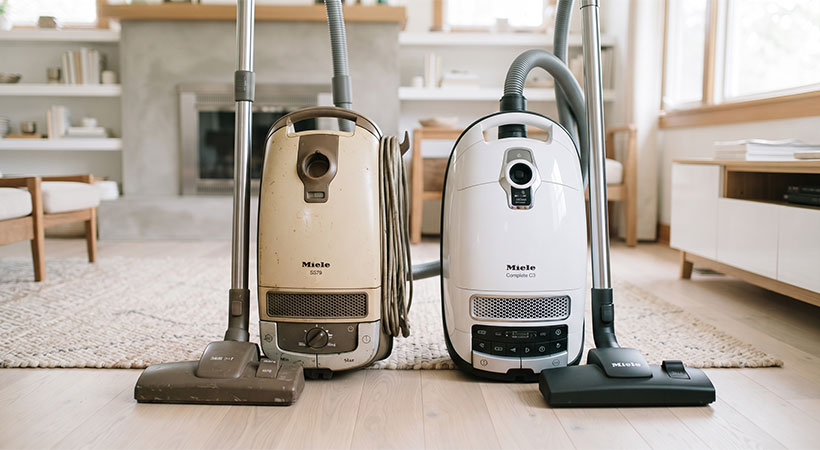
It is one of the most common questions we hear at the counter: “Be honest with me — is this thing worth fixing, or am I throwing good money after bad?”
It is a fair question, and the answer is not always the one people expect. Some vacuums that look rough on the outside are excellent machines with 10 or 15 good years left in them. Others look almost new but are built in a way that makes a real repair impossible. After years of opening up vacuums of every brand on our bench, we have learned that the decision usually comes down to five things: how the machine was built, what is actually wrong with it, whether parts still exist, what the repair costs compared to a replacement, and how hard your home is on a vacuum.
Here is how we walk customers through it.
Start with how the vacuum was built
Before talking about the specific problem, we look at what kind of machine we are dealing with.
Vacuums built to be serviced. Brands like Miele, Riccar, and Sebo are designed with maintenance in mind. Fasteners are accessible, motors and brushrolls are replaceable components rather than sealed assemblies, belts and bearings are standard parts, and the manufacturers keep parts in circulation for years after a model is discontinued. A 12-year-old machine from one of these brands with a bad motor or a worn brushroll is very often worth repairing, because you end up with a near-new machine for a fraction of replacement cost.
Vacuums built to a price. A lot of big-box and online vacuums are assembled with glued housings, proprietary sealed motor units, and plastic parts that are not sold separately. We can still fix plenty of them — clogs, hoses, belts, brushrolls, switches, and cord reels are all fair game — but when the failure is inside a sealed assembly, there is often nothing to replace. That is not a knock on the owner; it is just how the machine was designed.
So the first honest question is not “how old is it?” It is “can this thing actually be worked on?”
Then look at what is actually wrong
Most of the vacuums that come through our door are not broken in a serious way. They are clogged, worn, or neglected. Those are the good news repairs.
Usually well worth fixing:
- Loss of suction. Nine times out of ten this is a clog in the hose, wand, or floor head, a full bag or bin, or filters that have not been changed. This is one of the cheapest and most satisfying fixes we do.
- Brushroll not spinning. Typically a broken or stretched belt, hair and thread wrapped around the brushroll ends, or worn brushroll bearings. All replaceable.
- Worn brushroll bristles. A brushroll with stubby, rounded bristles stops agitating carpet, and people assume the vacuum “lost power.” A new brushroll transforms the machine.
- Damaged hoses, wands, cords, and cord reels. Very common, very fixable.
- Broken switches, height adjusters, and latches. Small parts, big difference in usability.
- Overheating and shutting off. Usually restricted airflow from filters or a clog, not a dying motor. Worth diagnosing before you assume the worst.
- Wheels, pedals, and hinges. Replaceable on most quality machines.
Worth a longer conversation:
- A genuinely failed motor. On a quality bagged upright or canister, a motor replacement often makes sense because the rest of the machine is still solid. On an inexpensive machine, the motor can cost more than the vacuum did.
- Cracked main housing or a broken chassis. If the body no longer holds a seal, filtration and suction suffer even after a repair.
- Battery failure in a cordless stick vacuum. If a genuine replacement battery is available, great. If the pack is sealed into the body or the brand does not sell it, you are usually looking at replacement.
- Robot vacuums. We can help with some models when parts are available, but many are closed systems.
Parts availability is the real deciding factor
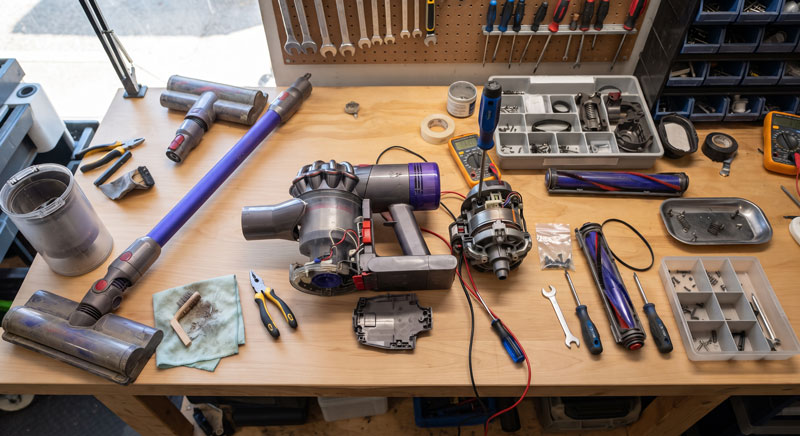
This is the part customers appreciate hearing straight. We can diagnose almost anything. Whether we can repair the vacuum depends on whether the part still exists.
Manufacturers discontinue models constantly, and parts support varies enormously between brands. Premium brands often have parts available a decade or more out. Budget brands may have nothing available two years after the model disappears from shelves. We also keep an eye on used and salvage parts for older machines, which sometimes rescues a vacuum that a manufacturer has walked away from.
If we cannot get the part, we will tell you plainly rather than charging you to chase a dead end. And if a repair is possible but genuinely not a smart use of your money, we will tell you that too. We would rather you trust us with the next machine.
The simple math we use
Here is the rough rule of thumb that keeps most people out of trouble:
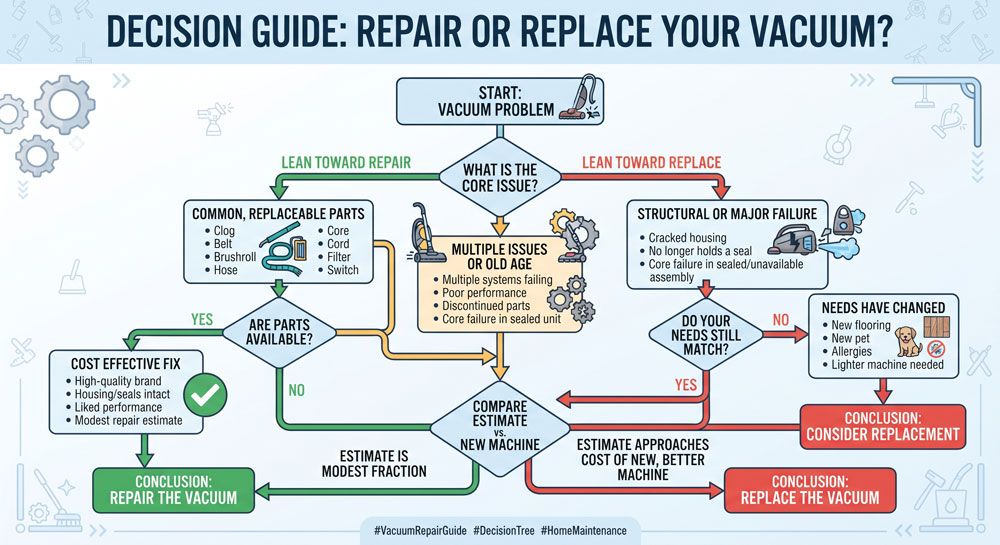
If the repair costs less than about a third to a half of what a comparable new machine of the same quality would cost, and the rest of the vacuum is in good shape, repair is usually the better value.
Two things matter in that sentence.
First, “comparable quality.” Comparing a repair on a well-built bagged upright to the price of the cheapest vacuum on a big-box shelf is not an apples-to-apples comparison. One is built to last 15 years with service; the other is often built to be thrown away.
Second, “the rest of the vacuum.” One repair on an otherwise sound machine is good value. Four things failing at once on a machine with cracked housings and worn seals is the machine telling you something.
There is also a cost people forget: a repaired quality vacuum that lasts another decade is far cheaper per year than replacing a budget machine every two or three years, and it keeps a working appliance out of the landfill.
What the Arizona desert does to your vacuum
Cleaning in the Phoenix, Sun City, and Scottsdale area is harder on a vacuum than cleaning in most of the country, and it changes the repair-or-replace calculation.
Fine desert dust is exactly the particle size that clogs filters, loads bags quickly, and works its way into bearings and motor housings. Add monsoon-season grit tracked in from the patio, pollen from our long allergy seasons, pet hair, and pool decks, and a vacuum here does more work per square foot than one in a humid climate with less airborne dust.
That is why we push so hard on sealed filtration and bagged systems for local homes. When a machine’s filtration is sealed and the dirt is captured in a bag you remove intact, fine dust does not get recirculated into the air you are breathing and does not keep grinding through the machine. It is also why routine maintenance here is not optional. Filters and bags changed on schedule prevent most of the “my vacuum died” calls we get.
If you or someone in your home has allergies or asthma, filtration quality should weigh heavily in your decision. A repaired machine with genuinely sealed HEPA filtration will do more for your indoor air than a brand-new machine that leaks fine dust out the sides.
A quick decision checklist
Lean toward repair if:
- The vacuum is a quality brand designed to be serviced
- The problem is a clog, belt, brushroll, hose, cord, filter, or switch
- Parts are available
- The housing, seals, and filtration path are intact
- You liked how it cleaned before it started acting up
- The repair estimate is a modest fraction of a quality replacement
Lean toward replacement if:
- The core failure is inside a sealed, unavailable assembly
- The housing is cracked or the machine no longer holds a seal
- Parts for the model are discontinued with no substitutes
- Multiple systems are failing at once
- Your needs have changed — new flooring, a new pet, a family member with allergies, or mobility needs that call for a lighter machine
- The estimate approaches the cost of a better machine that will last far longer
What happens when you bring it in
You do not have to figure any of this out on your own. Bring the vacuum in — and bring the attachments and hose, since the problem is often in them rather than in the machine.
We will inspect it, check airflow and suction, look at the brushroll, belt, filters, and seals, test the motor and electrical, and find out whether the necessary parts are available. Then we give you a straight recommendation: here is what is wrong, here is what it costs to fix, here is how long the machine should last afterward, and here is whether we would fix it if it were ours.
If repair makes sense, we do the work and you keep a machine you already know. If it does not, we will help you choose a vacuum that actually suits your floors, your household, and our dusty climate — and we will still be here to service it years from now.
Either way, you get an honest answer. That is the whole point of having a local vacuum shop instead of a return counter.